

Newton rings apparatus
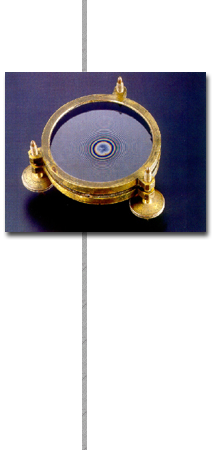
The device for Newton's rings is an interferential apparatus
with two beams by amplitude splitting and consists of a planoconvex
lens having a large radius of curvature lying with its spherical face
on the flat surface of a glass disk.
On illuminating the device from above with a parallel beam of monochromatic
light, it is possible to see a system of alternating light and dark rings,
known as Newton's rings, reflected on the surface of the lens. They are
generated by interference in the thin layer of air of varying thickness
between the lens and the flat surface it is lying on; they all have their
centre at the point of contact. The ring at the centre is dark and the
others become closer and closer together the farther they are from the
centre.
If the device is illuminated by white light the rings are coloured.
The rings are thus of equal thickness and are circular due to the
cylindrical symmetry of the device. ...continues

