
Two spectroscopes based on the Lummer-Gehrcke’s plate
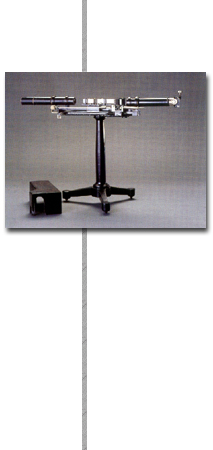
O. Lummer and E. Gehrcke, exploiting the fact that in the
passage from a more refracting means to one that is less refracting, if
the incidence is close to the limit value, the reflecting coefficient
is close to unity, invented and produced in 1903 the plate that bears
their name, which is a multiple beam interferometer.
It consists of a long plate of glass (or quartz crystal) with perfectly
smooth and parallel faces, in which the extremity transverse to the dimension
of greater length is cut obliquely, or one of the faces has a supplementary
prism on it. The slope of the face thus obtained is such that a parallel
beam almost normally incident to it then strikes the two faces of the
plate near the limit angle from the inside and is almost completely reflected.
As with any dispersive apparatus, the Lummer-Gehrcke interferometer plate
is used in spectroscopy by placing it between a collimator and a telescope,
obviously with the input face parallel to the slit of the collimator.
When a parallel beam of monochromatic light coming from the collimator
strikes the plate in the conditions described above, with every reflection
on its face only a small amount of light comes out and there is a succession
of parallel beams having more or less the same intensity. ...continues

