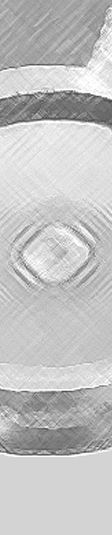

The discovery of the device goes back to 1665 and is attributed to Robert
Hooke (1635-1703) who in his Micrographia describes the coloured
rings produced around the point of contact in the thin layer of air between
two lenses with large radii of curvature placed one on the other.
He limited himself to describing the rings without measuring them but,
although his attempt at explaining them was based on a completely erroneous
principle, he guessed that they were caused by the beams reflected by
the two surfaces of the layer of air.
If we take into account the phase shift of p at the reflection between
air and glass, it is seen that the clear rings have a thickness the double
of which is equal to an odd number of half wavelengths and the dark rings
have a thickness the double of which is equal to an even number of half
wavelengths, with the consequence that for the former the thicknesses
are proportional to the odd numbers and for the latter to the even numbers.
The exact relationship between the radius of the rings, the thickness
of the layer of air and the radius of curvature of the lens can be determined
geometrically and, neglecting the square of the thickness with respect
to the square of the radius of curvature of the lens, from that relationship
it can be calculated that the radius of the generic ring is equal to twice
the product of the thickness of the layer of air multiplied by the radius
of curvature of the lens. ...continues