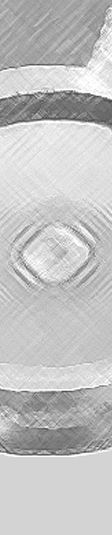

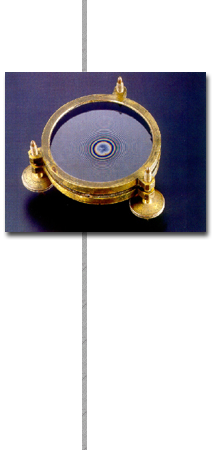
Newton rings apparatus
These rings bear the name of Newton who in 1672 had created the
device in order to observe them and had discovered experimentally that
the thicknesses of the layer of air in correspondence to the miscellaneousous rings
are proportional to integers.
In the exemplar in this collection, which belongs to the version of Newton's
apparatus that was most widely used in the 19th century, the lens and
the glass disk on which it lies are held by two sturdy brass frames having
a diameter of 8.3 cm, from which they protrude for just over a millimetre
in the parts facing each other.
The lens and the disk are held together by three long, equidistant levelling
screws arranged around the edge of the frames; they allow miscellaneousation of
the distance between them and also act as the feet of the device.
The bottom side of the disk is blackened to avoid the presence of the
beam reflected by it.
This device, when illuminated with a beam of monochromatic light, allows
observation of the fact that on increasing the distance between the lens
and the disk on which it lies by means of the levelling screws holding
them together, the clear rings occupy the place of the dark ones, converging
towards the centre, and this occurs with every removal by a quarter of
the wavelength.

