

Compound prism for the demonstration of achromatism
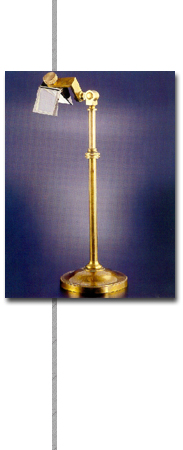
The achromatic prism is a system of prisms having different refraction
indices, which gives a deviation independent of wavelength; the simplest
one is with two prisms and, once two pieces of glass having much different
refraction indices have been chosen, to produce it, it is sufficient to
determine the refractivity angles and impose the condition that the deviation
shall be the same for two monochromatic components fairly far apart (for
example Fraunhofer's line C in the red and F in the blue) and that has
a fairly small (a few degrees) pre-established value for an intermediate
component (the Fraunhofer line D in the yellow).
The device presented here consists of two prisms, one of crown glass and
the other of flint glass (refractivity angle about half of the former),
with a frame of burnished brass; they can be superimposed but are upside
down with respect to each other; they are attached to a swivel joint at
the top of an extendible staff on a round brass base. They can thus rotate
above the staff and also around two axes at right angles to each other.

