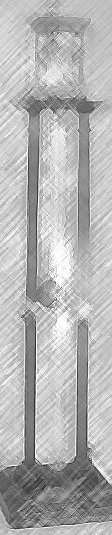


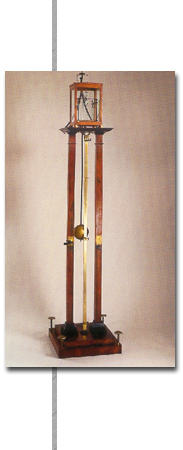
The Atwood machine, named after it inventor, George Atwood (1746-1807),
a professor at Trinity College at Cambridge, who reported
on it in 1784
Rotation takes place with no appreciable friction since both ends of the
axis of the pulley lie on the outside of two overlapping wheels having
non-coaxial horizontal axes following the arrangement devised by the watchmaker
Henry Sully and also used in the Desaguliers
tribometer.
In the machine described here, which has an overall height of 2.85 m,
the pulley (diameter 15.5 cm) and the two pairs of wheels (diameter 10
cm) on which its axis lies are assembled on a brass frame attached to
a square, wooden platform (47.5 x 47.5 cm) veneered with walnut root placed
at the top of two columns (height 2 m) of solid walnut. These columns
are in turn attached to a sturdy square basement (61.5 x 61.5 cm) this
too veneered with walnut root, with four levelling screws.
A brass plate attached to one of the two columns bears the words: Luigi
Lusvberg Macchinista in Roma 1828. ...continues

