
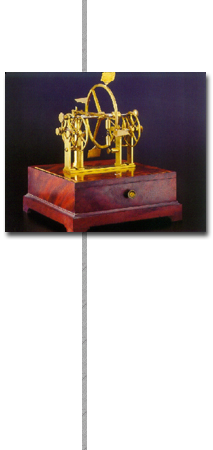
Desaguliers' tribometer is an instrument for the study of friction
that takes its name from that of its inventor: John Theophilus Desaguliers
(1683-1744), a professor of physics and renowned lecturer and demonstrator
at Oxford and at the Royal Society in London.
It consists of a light brass wheel (diameter 14 cm) at the centre, the
horizontal axis of which, instead of lying on fixed supports, lies freely
on both sides on the crossed outside of two mobile brass wheels with horizontal,
non-coaxial axes (diameter 7.5 cm).
Thanks to this arrangement, conceived by the genial watch-maker Henry
Sully (1680-1788), in which the axis of the central wheel transmits
its motion to the two pairs of lateral wheels; instead of producing sliding
friction, as would occur if it lay on fixed supports, it produces only
rolling friction and the motion takes place with no appreciable dissipation
of energy.
In the rest position the central wheel is kept raised by putting the ends
of its axis in empty cylindrical supports.
The instrument is made entirely of brass and its rectangular base, five
millimetres thick (width 16 cm, depth 4 cm) is fixed on a square box (sides
24 cm, height 6 cm) of polished wood with a drawer for storing accessories
and samples to be studied. ...continues

