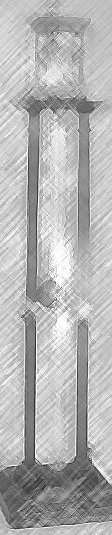

The importance of this machine lies in the fact that it allows the study
of a body's motion under the action of a constant force without having
to reach high speeds. Thus it is easy to measure the distance covered,
air resistance is negligible and the need to measure too small time intervals,
which are difficult to measure with the necessary precision, is avoided.
For this reason, Atwood's machine was widely used, first in research,
then in teaching dynamics and kinematics.
Along the graduated rule, it is possible to apply two cursors by means
of pressure screws. The first of these is provided with a ring which allows
one of the falling bodies, the one attached to the string, to pass through
it and not the one above it. The second has a disk that stops the other.
The trajectory is thus divided into two parts, the first of which is followed
with a naturally accelerated motion and the second with uniform motion.
By suitably adjusting the position of the two cursors in subsequent experiments
it is possible to study the two motions.
In what we have said thus far, we have not taken into account the fact
that besides the bodies suspended from the string and the added one, the
pulley and the two supporting wheels also participate in the motion.
The influence of the supporting wheels, which have a very small mass as
well as a very slow rotation speed, can be considered negligible. ...continues