
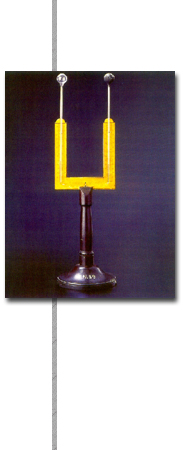
Leslie's thermoscope is a differential air thermometer
allowing the measurement of small differences in temperature. It was invented
at the beginning of the 19th century by John Leslie (1766-1832),
a professor of natural philosophy and mathematics at Edinburgh, who used
it in his important studies on radio energy. The instrument in our museum
is composed of a glass capillary tube in the shape of a U (width 11 cm,
height 22.6 cm) fixed on a wooden board, it too in the shape of a U and
supported by as column (height 21.5 cm) on a circular base (diameter 13.5
cm).
The capillary is filled up to approximately half of the vertical parts
of the tube with a liquid having a high vapour pressure that does not
evaporate at ordinary temperatures, such as sulphuric acid, and terminates
at the top with two large bulbs (diameter 2.44 cm) filled with air. The
air is the thermometric fluid, while the sulphuric acid simply acts as
an index and is generally dyed red. In this instrument it is colourless.
...continues

