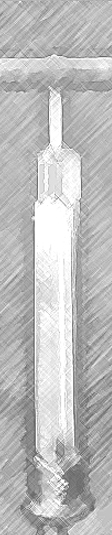

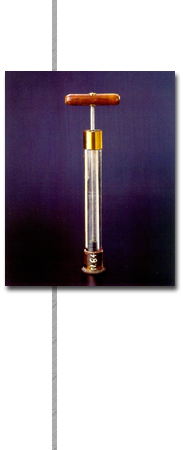
The pneumatic lighter is an instrument for use in demonstrations
which is composed of a cylinder the ends of which are metal; the walls
are of the same metal or very thick glass. One of the ends is closed while
the other is open to allow insertion of an iron rod with an airtight piston.
The rapid and violent raising and lowering of the piston causes an adiabatic
compression of the air; the consequent rise in temperature is so sharp
that it causes kindling wood
previously placed in the cylinder to catch
fire immediately. Indeed, a sufficiently quick compression, which reduces
the volume by one twelfth of its initial value, causes a rise in temperature
of about 500° Celsius.
The specimen on display here is made up of a glass cylinder (diameter
2.5 cm, height 21 cm), the walls of which are about 3 mm thick, and the
piston is a brass cylinder 3.2 cm long, with a liner of leather to make
it airtight. The piston shaft is made of iron and the handle is a wooden
cylinder fixed horizontally at the top of the shaft. The extremities are
made of brass.

