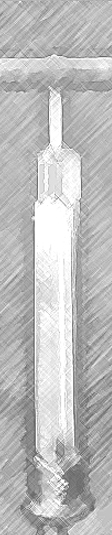

Towards the end of the 18th and the first years of the 19th centuries
the processes of adiabatic expansion and compression of gases were studied
by John Dalton (1766-1844) and Joseph Louis Gay-Lussac (1778-1850),
who some consider the inventor of the pneumatic lighter; but the phenomenon
was discovered by chance in 1802 by a worker in a St. Etienne arms factory
who observed that a thread of linen in the barrel of a compressed-air
gun had caught fire after the gun was shot. The discovery was announced
to the Académie in Lyon on 20 December of the same year
by Joseph Mollet, a professor of physics at the Ecole Centrale
in Lyon, and commercial production of pneumatic lighters began in 1805
in the Paris factory of the Dumotiez brothers. Both in the metal and glass
versions, the lighter was used for demonstrative purposes throughout the
19th and in the first half of the 20th centuries.
It is interesting to observe that in inventing his engine, Rudolph
Christian Karl Diesel (1858-1913), the first of which was assembled
in 1897, was inspired by a lecture on and demonstration of the pneumatic
lighter that he had witnessed.
The Diesel engine is an internal combustion engine in which ignition is
not caused by an electrically produced spark, but takes place spontaneously
when the liquid fuel is injected in an atomized state into the cylinder
by effect of the high temperature reached by the air contained in it in
a
previous
compression phase.