

Solar polariscope
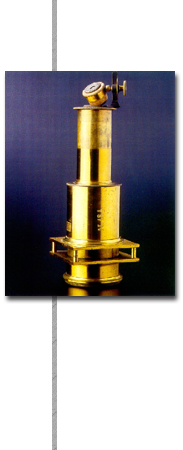
The first is, in turn, divided into two parts by two square plates, about
2 cm apart from each other, between which is inserted, with a special
support, the crystalline specimen or tempered glass.
At the front end of the second tube there is a converging lens of the
same diameter (about 9 cm) which gives an image of the specimen slightly
before the focus of a second converging lens placed at the entrance to
the third part of the tube, and this projects it onto a screen.
A Nicol prism, placed between the second lens and the screen, produces
interference between the monochromatic components of the beam which vibrate
along their own transmission axes and the image on the screen appears
with varying colours; on rotating the Nicol prism, the interference figure
changes and so do the colours, which are brighter when it is crossed with
the polarizer.
In the exemplar presented here, the part of the support to which the Nicol
prism was attached is missing. For this reason it was fitted with a ring
without compromising the working of the instrument. The ring is on the
same support closest to the second lens for holding crystalline plates
or tempered glass set at the centre of special round cork frames. ...continues

