
It was the French physicist Ètienne Louis Malus (1775-1812)
who in 1808 discovered polarization by reflection, on observing
that a beam of natural light reflected by the surface of a transparent
means, whether solid or liquid, is partially polarized linearly and vibrates
perpendicularly to the incidence plane.
Merit for the discovery of polarization by refraction also belongs to
the same Malus who, at the end of 1809, had observed that even the transmitted
beam is partially polarized and vibrates perpendicularly to the direction
of vibration of the reflected beam; this, in the case of a plate, is also
true for the beam reflected by the second face which comes from the one
that went through it.
Instead, it was the Scotsman Sir David Brewster (1781-1868) in
1815 who established, after a long series of high-precision measurements
that the reflected ray is totally polarized when the tangent of the incidence
angle is equal to the refraction index of the reflecting material (Brewster's
law) and for this reason that of incidence is known as Brewster's
angle.
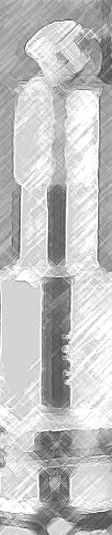
The solar polariscope was invented and proposed, in the first half of
the 19th century, by the Paris optical instrument maker Jean Baptiste
François Soleil (1798-1878) for use in teaching and for lectures
to project onto a screen the coloured figures that are generated when
a beam of white light that is linearly polarized, after passing through
a crystalline plate (natural birefractivity), or a plate of tempered
glass (artificial birefractivity), through a linear polarizer.
Other kinds of polariscopes, illuminated by sunlight or an arc lamp, were
created and marketed for use in lectures to show the figures to a vast
audience whose interest was stimulated by the spectacular changes in colour.