
Biot apparatus for the study of polarization
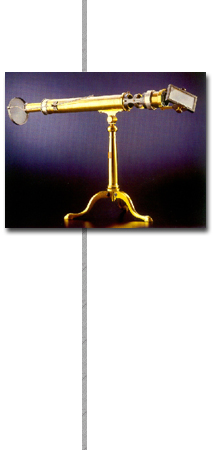
What is presented here is one of the many versions of the devices created
or modified by Jean Baptiste Biot (1774-1862) for the study of
light polarization phenomena in general and polarization by refraction
and the rotatory power of quartz plates cut normally to their optical
axis in particular.
The instrument is made of brass, the polarizer is composed of a
stack of eight plates of transparent glass, parallel to each other
and at a slight distance from each other, and the analyser is a
Nicol prism.
The stack of plates is free to rotate around the axis passing through
the suspension pins and around the axis of the tube. Its inclination is
measured on a disk graduated from 0 to 360 sexagesimal degrees, two degrees
at a time; its orientation and that of the Nicol analyser are measured
on scales subdivided into sexagesimal degrees from 0 to 360 on the silver-plated,
revolving cylindrical collars to which they are joined.
The samples to be studied, mounted on cork disks, are fixed to a brass
collar that can slide and turn, with slight friction, around a diametrically
hinged ring attached to two arms that join the initial part of the tube,
to which the polarizing stack is attached, to the rest of the instrument.
The sample can thus be oriented in any way around the axis of the tube
and, since the ring can turn around the axis passing through the pins,
it can assume any inclination whatsoever.
...continues

