
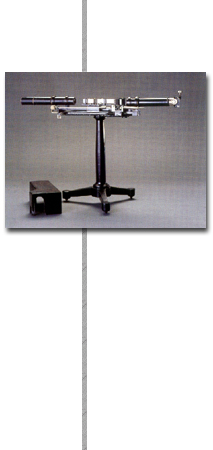
Two spectroscopes based on the Lummer-Gehrcke’s plate
They emerge almost sliding from one face and from the other and the objective
of the telescope makes them converge and interfere on its own back focal
plane.
Since the incident beam is not perfectly parallel, systems of beams with
slightly different inclinations emerge from the plate and there is the
formation of a system of fringes of equal inclination on the telescope
focal plane.
The difference in the optical path between two consecutive beams, for
a given inclination, is:
(1)  D=2ndcosr
where r is the angle of plate-air incidence, n is the refraction index
and d the thickness of the plate. Therefore, for monochromatic light having
a wavelength l, the order of the spectrum is:
m=D/l.
The number N of beams that interfere can easily be obtained by dividing
length l of the plate by the distance
(2) d =2dtgr
between two consecutive reflections.
Since r differs slightly from the limit angle, we can place sinr=1/n and
express in (1) cosr and in (2) tgr as a function of n; thus for n=1,5
and l=500nm, since l=10,7 cm and d=3,25 mm, for the laminas of the spectroscopes
presented here, we have the number of beams N=18, the order m=14560 and
the resolving power mN=262000. ...continues
