
Two spectroscopes based on the Lummer-Gehrcke’s plate
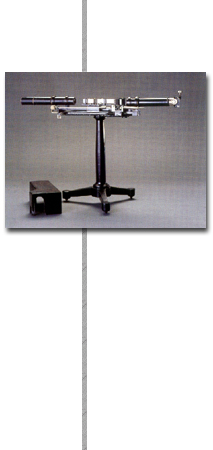
With longer plates it is possible to reach resolving powers above 600,000
The Lummer-Gehrcke plate, like echellette grating and all other high resolution
instruments, was used exclusively in the study of the fine structure of
spectral lines in combination with an auxiliary spectroscope that separated
the line to be analysed (monochromator).
The Lummer-Gehrcke quartz crystal plate, since it is transparent up to
about 200 nm, was for many years the best dispersive apparatus in high-resolution
spectrography in the ultraviolet.
In the two spectroscopes that are presented here, which were made by the
same hand and are perfectly identical, the telescope and the plate are
arranged on the median line of a rectangular platform (25 x 7 cm) of cast
iron painted black held by a column 24 cm in height and by a heavy tripod,
both of cast iron painted black.
The telescope can turn by a few degrees around the position at which its
axis is parallel to the plate and the axis of the collimator. ...continues

