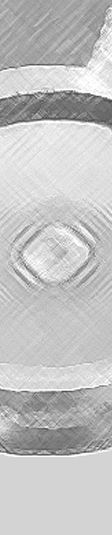

Therefore the radii of the clear rings are proportional to the square
roots of the odd numbers and the radii of the dark ones are proportional
to the square roots of the even numbers.
That the rings become tighter and tighter the farther they are from the
centre is caused by the fact that, as the distance from the centre increases,
the layer of air increases more rapidly and there is a faster passage
from a ring of a certain order to that of the subsequent ring.
If the plate of glass on which the lens lies is completely transparent,
the rings can be observed even in transmission; but in this case, since
there is no air-glass reflection, there is no phase shift of p and, in
monochromatic light, in correspondence to a reflected clear ring one observes
a dark transmitted one and vice versa.
On the contrary, in white light, a transmitted ring of complementary colour
corresponds to a ring of a certain reflected colour.
All this is in agreement with the principle of energy conservation which
states that the sum of reflected intensity and transmitted intensity is
equal to the incident intensity, possibly with the subtraction of absorbed
intensity, and is thus constant.
Therefore, if the reflected or the transmitted intensity is at its highest,
the other must be at its lowest.
It must, however, be kept in mind that if, under monochromatic light,
the surfaces of the lens and the underlying disk facing each other are
not suitably treated, with reflection the minima of interference are approximately
null and the rings are dark, while with transmission the minima are not
null and the rings are not dark. ...continues