

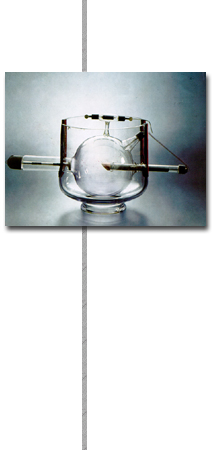
The x-ray tube presented here, like all the first models, is a
focusing tube, which is to say a tube in which the electrons are
focused by the same aluminium emitting cathode, which is concave, on a
very limited zone of the anticathode. Its overall length is about 50 cm
and it consists of a central, spherical part and two lateral, cylindrical
branches diametrically opposed, each one some 18 cm in length; on one
side there is the cathode, which lies in correspondence to the surface
of the spherical part, and on the other side, directly facing the cathode,
there is the anticathode, which lies in the centre.
The emitting plate of the anticathode is set in a large block of metal
in the form of the mouth of a flute, which is placed at the extremity
of a thin, cylindrical, metal sheath which favours cooling.
At approximately 45 degrees with respect to the anticathode there is the
anode, which consists of a small aluminium cylinder about 5 cm long.
In old x-ray tubes, when working, the gas particles adhered to the glass
walls and the vacuum decreased; the x-rays became more and more penetrating,
the images less and less contrasted and at a certain point the tube could
no longer be used; for this reason almost all of them were equipped with
a regeneration device which could emit small quantities of gas,
thus re-creating the pressure necessary for their proper working. ...continues

