

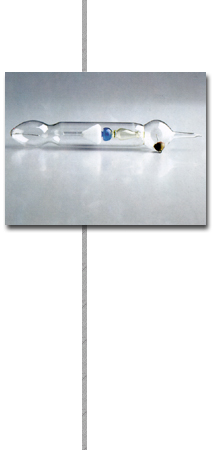
If we consider that Sir William Crookes (1832-1919) had communicated
the results of his discharge tube experiments with extremely rarefied
gases in 1879, we can see that this tube, inventoried in 1881, is of great
historical importance. The central part of the tube, which is obviously
all made of glass, is cylindrical (diameter 2.6 cm, length 8 cm) while
one end is an ovoid and the other a sphere.
Of the two linear electrodes one, 3 cm long and oriented in the direction
of the axis of the tube, is soldered to the ovoid end and the other is
soldered to the spherical part, perpendicularly to the axis of the tube,
with the free end falling slightly beyond the axis.
The spherical end communicates with the rest through a diaphragm to which
a tube, coaxial with the main one, is attached. The former is made up
of four parts with glass of different qualities; one of these is yellowish
and has the shape of a vase with a narrow neck and bottom. It is followed
by a blue hemispherical one, then a conical one that is white and opaque
and finally a small transparent tube. ...continues

