
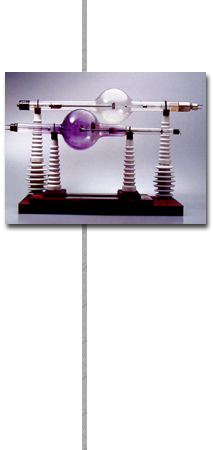
It is a large x-ray tube of the Coolidge type having a length
of 100 cm mounted on a wide wooden platform by means of two porcelain
insulators 40 cm in length.
Coolidge tubes differ from focus
tubes in that their vacuums are far greater, the electronic
beam is produced by thermoionic effect and the anode acts as the anticathode;
they deliver far more intense beams of x-rays and, being more regular
and constant, they replaced focus tubes in the long run.
In the tube presented here, the cathode is a small, flat spiral
protected by a thin, cylindrical sheath and the anticathode is
a thick, square plate (about 3 x 3 cm) at an angle of 45 degrees, held
by a long cylindrical tube of metal having very thin walls, which favours
cooling.
A testing label dated 16 June 1929 indicates that the maximum working
tension is 160 kilovolts, the discharge current is 4 milliamperes and
the maximum supply current is 4.2 amperes.

