

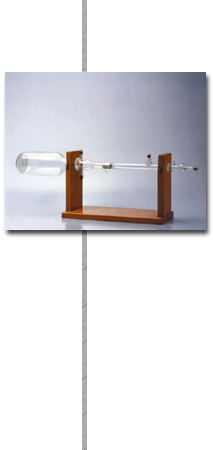
Tubes of the kind presented here took their name
from Carl Ferdinand Braun (1850-1918), a professor of physics at
the University of Strasbourg, who in 1897 had modified a cathodic ray
tube by inserting two parallel metal plates and coils.
In this way a well collimated beam of cathodic rays could pass through
an electric or a periodic magnetic field perpendicular to the direction
of the beam; the movement of the luminous spots produced on a small, fluorescent
screen placed at the end of the tube followed the oscillations of the
electric or magnetic field through which the beam had passed.
Braun, on joining this modified tube to a rotating mirror, had created
an oscillograph which made it possible for him to study electric oscillations
with frequencies above 100 kilohertz in his research in the field of wireless
telegraphy.
What we present is a tube with a high vacuum (pressure lower than 1/1000
mm of mercury) which is 78 cm in length on a polished wood support. ...continues

