
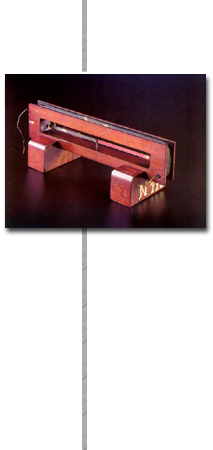
Designed by Johann Solomon Christoph Schweigger (1779-1857), professor
of chemistry at the Le Halle University, who presented it on 16 September
1820 before the Natural Philosophy Society of that city, the apparatus
consists of a coil of copper wire wound on a rectangular wooden frame
(29 cm x 6.5 cm), in the centre of which a large magnetic needle lying
on a special pointed stand is free to rotate. When electricity flows through
the coil, since the electricity passes through all the turns in the same
direction, they exert equal and concordant actions on the needle and it
thus undergoes a far stronger action than would be produced by a single
turn.
From this derives the name of multiplier attributed to it later on, but
Schweigger continued to call it simply a duplication apparatus.
The working principle is that of a mobile needle galvanometer. With the
addition of a graduated circle the multiplier becomes a true, albeit primitive,
galvanometer.

