

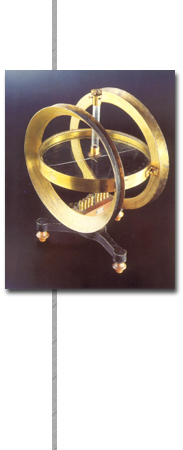
The tangent galvanometer was one of the most frequently used mobile
magnetic needle galvanometers in the middle of the 19th century. It was
invented in 1837 by the French physicist Claude Servais Mathias Pouillet
(1791 1868), together with the sine galvanometer. The two instruments
are so called because the current intensity is proportional to the tangent
and sine of the needle's rotation angle respectively. In its traditional
form it is composed of a small magnetic needle suspended from a thread
having a negligible elastic moment of torsion, in the centre of a circular
vertical coil through which the current to be measured passes. The same
thread holds an index that allows reading of the rotation angles on a
fairly large graduated scale (radius 10÷15 cm).
The instrument is prepared for measurements by rotating it around a vertical
axis until the magnetic needle, which without current is subject to the
earth's magnetic field only, lies on the plane of the coil. Then, on applying
the current to be measured to the instrument, the magnetic needle becomes
subject to the simultaneous action of the horizontal component of the
earth's magnetic field, which lies on the plane of the coil, and the field
created by the coil, which is directed perpendicularly to that plane.
...continues

