

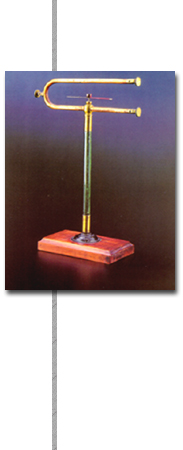
Its purpose is to demonstrate, by means of
the deviation of a magnetic needle, that a conductor through which electricity
passes creates a magnetic field: this is the Oersted effect discovered
by the Danish physicist and chemist Hans Christian Oersted (1777-1851)
who published the results of his experiments in Copenhagen on 21 July
1820.
The apparatus consists of a large copper conductor bent into the shape
of a U (length 19 cm, distance 4 cm) held by an glass insulating rod on
a wooden base and a magnetic needle placed between the two branches of
the U. Three clamps, one in common placed at the base and the other two
at the ends of the conductor make it possible to connect the branches
to a generator one at a time, in series or in parallel.

