
Thermoelectric cell

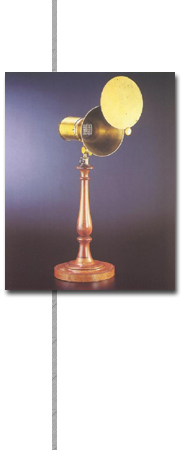
The thermoelectric pile designed by Leopoldo Nobili (1784-1835),
professor of physics at the Institute and Royal Museum of Florence, consists
of a series of bismuth and antimony bars connected in a zigzag pattern
so as to form a right parallelepiped with a square base.
In this exemplar, which is quite similar to Nobili's original model, the
antimony-bismuth couples are thirty-six in all and are arranged in six
files of six couples each.
Both the bases of the parallelepiped have a side of 3.8 cm and the odd-numbered
connections are all on one of them and the even-numbered ones are all
on the other.
The two elements at the end of the series are connected to two clamps
dislocated horizontally on the surface of the side of a cylindrical brass
case (diameter 9 cm, height 12 cm) containing the entire parallelepiped
and is connected to a trumpet-shaped receiver.
The apparatus is held by a hinged brass staff which, being capable of
sliding inside a column (with a circular base in lathed wood), allows
miscellaneousation both of its orientation and its height (maximum 72 cm, minimum
45 cm). ...continues

