

Thermoelectric cell

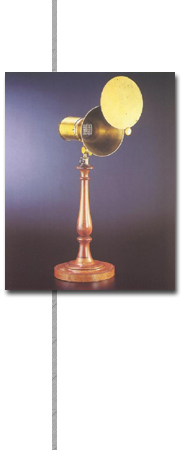
If one of the bases is heated, a difference in potential forms, depending
on the difference in temperature and equal to thirty-six times what there
would be if only a single couple were used between the two clamps.
The device, when connected to Nobili's astatic galvanometer, represents
a differential thermoscope of very high sensitivity (which Nobili
called a Termo-Scopio Elettrico or Termo-Moltiplicatore)
and the two blackened bases make it a good detector of integral radiation.
The sensitivity of this thermoelectric pile is greatly increased by the
use of the trumpet receiver; in fact, on turning the trumpet towards the
source, the radiation that strikes the internal surface of the two walls,
which have a very high degree of reflectivity, is concentrated on the
pile.
The other face of the pile is protected by the cylindrical brass case
and a lid, it too brass, which closes the free base.
This pile, which was modified on the suggestion of Macedonio Melloni
(1798-1854) professor of physics in Parma, was used by Nobili
and Melloni for research on radiant heat, the results of which
were presented to the French Academy of Science in Paris on 5 September
1831.

