
It was John Friedrich Wilhelm Herschel (1792-1871) who had the idea of overcoming these difficulties and obtaining interferences of sufficiently long duration by dividing the two waves from the same source and superimposing them after they had followed different paths.
The approach proposed by Herschel in the Philosophical Magazine in 1833 was followed by Georg Hermann Quincke (1834-1924) who published the results of his research in Poggendorff's Annalen in 1866.
The apparatus suggested by Herschel and later improved by Quincke, from whom it took its name, was further improved by Karl Rudolph Koenig (1832-1901) in a version that allowed the performance of interference experiments with great ease.
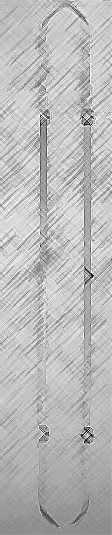
In Koenig's apparatus the sound of a tuning fork is sent through a resonator to a tube that separates into two U-shaped branches, one fixed and the other telescopically extendable.
The free ends of the two branches are connected to two manometric capsules, each of which has two outlets; one of these feeds a common burner and the other a burner of its own.
The waves that travel through the two branches have the same frequency and at the branching point also have the same intensity and phase; at the outlet they still have the same frequency and the same intensity, but different phases if they followed different paths. For the whole time that the length of the two branches remains the same the difference in phase remains constant ...continues