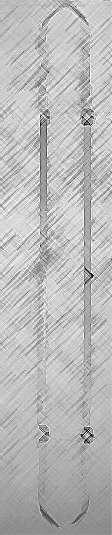

When the lengths of the two branches are equal or differ by a whole wavelength number, the waves that have travelled through them come out in phase and the flames of the manometric capsules, analyzed by means of the rotating mirrors, present equally-spaced teeth but in those of the common burner the teeth are higher than in the other two.
When the lengths of the two branches differ by an odd number of half-wavelengths, the waves that have travelled through them come out in opposition, the flame of the common burner appears immobile and the image reflected by the mirrors appears as a continuous stripe, while the flames of the other two burners oscillate and the images in the mirrors are grooved stripes in which a groove of one corresponds to a tooth of the other.
Also quite widespread are the models of the Quincke tube in which the ends of the two U-shaped branches come back together into one and the same tube through which the interference can be observed both subjectively, by placing the eye close to the outlet, and objectively, with the aid of a manometric capsule and a system of rotating mirrors.
When the lengths of the two branches are the same, or differ by a whole wavelength number, the exiting waves are in phase and the ear hears an intense sound which, by slowly lengthening or shortening the movable branch, becomes softer and softer until it disappears when the lengthening or shortening becomes a half-wavelength.
Once the wavelength has been measured with the Quincke tube, it is possible to calculate its propagation speed if the frequency of the sound used is known.