
The most commonly used apparatus for the study of the interference of
sound waves in air is sometimes presented as the Herschel apparatus,
but its most widely used name is Quincke tube.
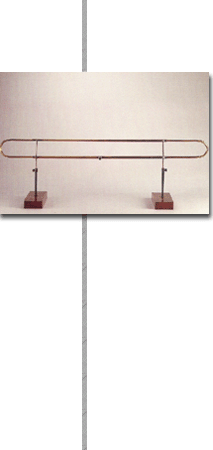
The exemplar shown here is one of the simplest models of the Herschel-Quincke
tube which, by allowing direct observation of interference phenomena,
is more effective in teaching than the more sophisticated instrument manufactured
and sold by Koenig.
It is composed of two copper tubes (diameter 1.4 cm, length 80 cm) joined
together and held parallel at a distance of 8 cm by two copper staffs
soldered to them near their ends.
The two staffs, which slide inside two iron supports on sturdy wooden
bases, can be raised by some 15 cm, thus allowing the horizontal tubes
to be set at different heights.
The ends of the two tubes are joined at the ends by two U-shaped copper
tubes which, being able to slide inside the others, can be lengthened
telescopically.
The two fixed tubes communicate with the outside by means of two short
horizontal tubes in the centre: one for the input of sound waves and the
other for the output.

