
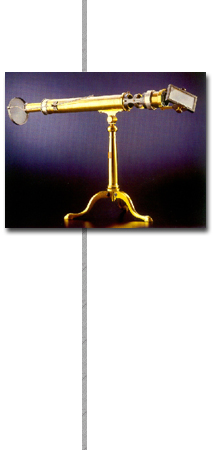
Biot apparatus for the study of polarization
The inclination is measured on a disk graduated from 0 to 360 sexagesimal
degrees, two degrees at a time, and the orientation on a scale, divided
into sexagesimal degrees from 0 to 360, marked on the edge of a collar.
The beam coming from the polarizing stack has gone through the sample
and is made to converge on the analyser with a lens placed inside the
tube which gives an image on a disk of frosted glass fixed to the tube
by means of a long, burnished brass rod which, on sliding along the block
of the support, allows it to be set at different distances from the analyser.
The stack of plates illuminated by Brewster incidence with a parallel
beam of natural light can, by reflection, direct a beam that is totally
polarized linearly, which vibrates perpendicularly to the incidence plane
into the tube or, by refraction, deliver a beam that is partially polarized
linearly with a good degree of polarization which vibrates on the incidence
plane.
The apparatus, which is all brass, has an overall length of 84 cm, it
is 44 cm high and is held by a sturdy column on a well worked tripod with
jointed feet.
The tube has a diameter of 5.4 cm and is blackened on the inside.
The frame of the polarizing stack, the sample holder and the arms that
hold it are burnished brass; the scales on which the orientation of the
polarizer and the analyser is measured are silver-plated.

