
Diffraction apparatus
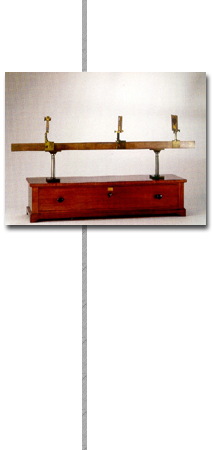
The diffraction benches that belonged to the Physics Laboratory
in the second half of the 19th century and the first decades of the 20th
are essentially represented by a graduated metal rod on which cursors
slide; to these are attached, or can be attached, plates having vertical
rectangular openings in which supports for the different accessories used
in the production and observation of a wide miscellaneousty of interference and
diffraction phenomena can be inserted by means of sliding guides.
In the exemplar presented here, the rectangular graduated rod (length
125 cm, thickness 0.5 cm) is brass and is attached by means of brass columns
to a bench of polished mahogany (length 103 cm, height and depth 24.5
cm) with a large drawer for accessories.
On the cursors there is the index for the graduated scale followed by
five divisions of one millimetre each.
The plates in which the openings have been made for the insertion
of the frames for the accessories are square (11 x 11 cm) and the openings
are rectangular (height 6.6 cm, length 3 cm). ...continues

