
Fittings for the diffraction apparatus
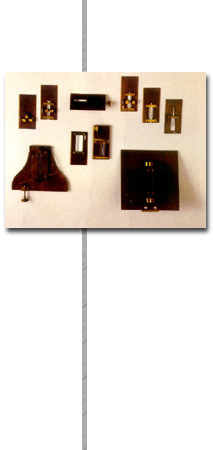
A pair of Fresnel mirrors and a biprism, small metal
rods and round openings of different diameters, slits
of different widths, a metal rod with a long, thin point.
There is also a small plate of glass with a round, opaque
disk with a diameter of about one millimetre to perform the experiment
with which Fresnel showed that at the centre of the geometric shadow of
a round opaque disk a clear fringe always forms.
A small plate of blackened glass about 2 mm wide is used to show
diffraction by reflection.
Also available are one Young's apparatus consisting of two round openings
and another one consisting of two identical slits in which a small mobile
screen allows the covering of one of the apertures to show that the interference
figure of the two apertures is superimposed on the diffraction figure
of one of them; in one of the accessories a small, thin, sliding plate
of glass can cover one of the slits of one of Young's apparatuses to show
the consequent shift of the interference fringes from the part of the
covered slit.
Using the edge of a razor blade to cover one of the edges of one of the
small metal rods present among the accessories, it is possible to perform
the experiment in which Young discovered interference by observing that
in the shadow of a wire (or rod) the internal fringes are generated by
the superimposition of beams diffracted by its edges. ...continues

