

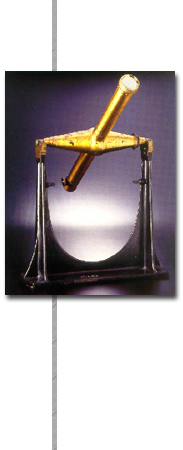
Brass telescope with base holder
The declination is the angular distance of a star from the
celestial equator in the direction of the poles and it is immediately
seen that it is the analogue of the latitude. With the aid of the micrometers
placed on the columns holding the instrument, the zenith distance
is measured on the graduated circle and from this, knowing the latitude
of the place of observation, the declination can be calculated.
The right ascension is the analogue of the longitude, but it is
measured in hours, minutes and seconds; it is determined by finding the
instant at which the passage of the star at the meridian takes place.
This is performed by using, together with the transit circle, a clock
set by sidereal time.
The following are missing in the exemplar presented: the lateral graduated
circle, the micrometers, the reticle and the semi-transparent mirror for
illuminating it, which was at the centre of the eyepiece tube between
the two lateral arms.
It lies on a heavy cast iron stand composed of two vertical buttresses
(height 50.5 cm) on a rectangular base (58 x 18.5 cm).
The telescope tube is cylindrcal (length 80.4 cm; diameter 58.5 mm) and
the two side arms are hollow and in the form of a truncated cone (overall
length 47 cm, diameter of each 9.5 cm and 3 cm; the tube and the two arms
are connected to each other and communicate at the centre. ...continues

