
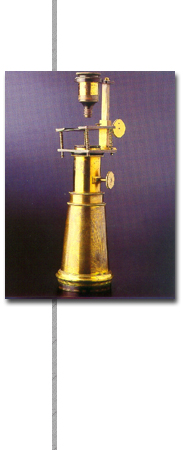
The parts of the exemplar on display, which is the one that was most widespread
in the 19th century, are:
· the brass tube consisting of two pieces, one a truncated
cone  (diameters
9 and 6 cm; length 14.5 cm) and the other a cylinder
which slides, with an extension of 11 cm, inside the narrower
part of the former;
· the shelf for objects on which the support for the slides
moves;
it is burnished brass, at the centre it has a circular aperture
and lies with four pins with spring spacers on another
burnished brass plate attached to the narrower end of
the tube;
· the objective, composed of a system of converging lenses
of short
focal length held by a staff which, by means of a rack screw,
allows it to move towards or away from the slide.
At the wider end, the microscope tube is threaded so that it can be screwed
onto the heliostat and it has a converging lens which, by completely covering
the aperture, captures the sunlight reflected by the heliostat mirror,
making it converge onto one lens placed at the end of the tube which,
in turn, makes it converge on the object. ...continues
