
Stereoscopes, depending on the optical device they use to convey
to each eye the light coming from one only of the pair of images, are
called mirror stereoscopes or refraction stereoscopes.
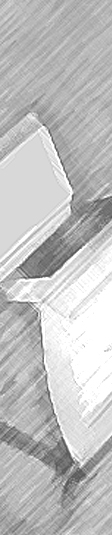
The mirror stereoscope, invented in 1832 by Charles Wheatstone
(1802-1875), consists of a straightedge, which in the original model was
wood, at the ends of which there are two vertical screens perpendicular
to them on which the two reproductions of the object to be viewed are
attached; at the centre of the straightedge there are two flat, vertical
mirrors at right angles to each other, with the common edge lying on the
plane perpendicular to the straightedge.
By looking at the angle formed by the mirrors it is possible to see, separately
and simultaneously, the image fixed to the screen on the right with the
right eye and the one on the left screen with the left eye.
The distance and positions of the mirrors and their screens are adjusted
so that the images supplied by the two mirrors overlap behind the straightedge.
In refraction stereoscopes the two reproductions, placed side by side
in a single frame, when they are on glass, transparent paper or film,
are observed with transmitted light and are illuminated from behind through
a plate of frosted glass which covers the front face of the instrument
almost entirely; when the images are on opaque paper, they are viewed
in diffused light and are illuminated by means of a mirror hinged to the
upper part of the instrument. ...continues