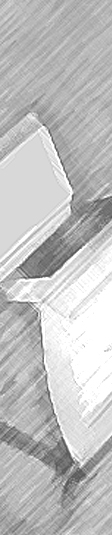

In refraction stereoscopes, invented in 1849 by David Brewster
(1781-1868), the two reproductions are viewed through two prismatic lenses,
one for each eye, which can be described as composed of two converging
lenses to which two prisms having a small refractivity angle are attached
in the front, with the edges turned towards the axis of the instrument.
The lenses give two virtual images of the two reproductions at the distance
of distinct vision which the two prisms, on deviating their incident rays,
superimpose; thus a single image is observed in a position between the
two giving the perception of rises and depressions in three dimensions.
When Brewster announced his brilliant idea of the refraction stereoscope
in 1849, he could not find opticians willing to construct it. He therefore
turned to Jules Duboscq (1817-1886) son-in-law of the famous Paris optician
Jean Baptiste Francois Soleil (1798-1878), from whom he had inherited
the workshop in Rue de l'Odéon.
Duboscq presented an exemplar at the great exposition in 1851 where it
was admired by Queen Victoria who, fascinated by the spectacular three-dimensional
images it gave, introduced it into her London drawing-room.
The stereoscope thus became a spectacular drawing-room object and, as
such, from the Court it rapidly spread throughout Great Britain and the
rest of Europe, together with the kaleidoscope, which it equalled in commercial
success.