
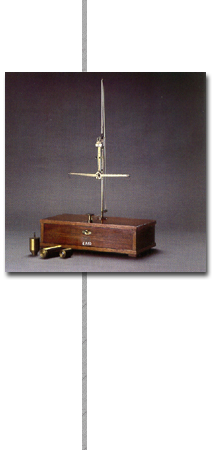
The Mohr level is a version of the water level and, like the latter, is used for the experimental demonstration of Archimede’s principle.
The water level, invented by Galileo Galilei (1564-1642), differs from ordinary two-armed scales in that each scale pan is equipped with a hook on the bottom at the centre and that the beam can be raised and lowered by means of a rack.
Two stops, one on one side and one on the other, limit the range of movement of the beam.
The Mohr level in the museum differs from normal hydrostatic levels in that it has no scale pans and the hooks from which the two cylinders are suspended on one side and the balancing counterweights on the other side are at the extremities of the beam. The staff on which the beam is suspended (height 48.5 cm) is attached to a box of varnished wood (width 35 cm, depth 18 cm, height 10 cm) with a large drawer containing the accessories.
The suspension of the beam, which is 24 cm long, slides by some 18 cm at the highest point of the staff, held by a string that is wound around a brass cylinder turned by a handle joined to and coaxial with it.
Oscillations are limited by a small brass plate bent into a U, attached to the suspension staff, inside of which the needle moves.

