
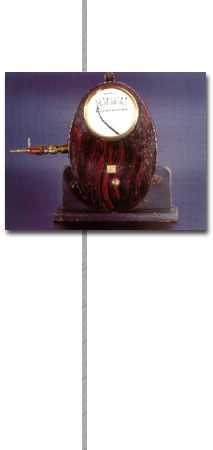
Built and patented by the French engineer Eugène Bourdon (1808-1884)
who had invented it in 1849, this is a metal manometer
inside a sturdy painted iron case having an elliptical cross section (23
x 32.5 cm, depth 6 cm) that has at the top a dial with a scale for reading
the pressures and lower down a brass button bearing the inventor's initials
E.B. An L-shaped wooden support, to which it is attached, keeps it in
a vertical position.
It is composed of a copper tube having an elliptical cross section. It
has thin walls and is flexible, slightly flattened on one side and bent
twice into a spiral in the flattened part.
One of the ends is attached laterally to the case with a pipe union with
a cock which allows connection to the recipient in which the pressure
is to be measured; the other end is free and closed and terminates with
a steel index that moves on a graduated scale.

