
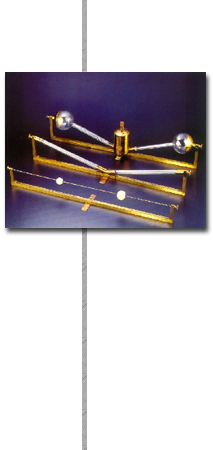
In the other two accessories, which are used to demonstrate centrifugal
force with liquids, the frame is not closed at the top but holds the recipients
with the liquids in a suitable position.
One has at the centre a cylindrical recipient (height 11.5 cm, diameter
8 cm) which is filled with a liquid, which is usually coloured water,
and which communicates, near the base, with the opening of two spherical
bottles (diameter 10 cm) with a long, narrow neck (diameter 2 cm, length
22 cm), the bowls of which are held by two spherical brass caps attached
to the vertical arms of the frame.
When the device is made to rotate, the liquid rises up to the bowls and
then goes down when the rotation ceases.
The other frame has two glass tubes (length 38 cm, diameter 2 cm) containing
water, closed at the base and sloping toward the centre, with one end
attached to the centre of the frame and the other to the upper part of
the vertical arms of the frame.
One of the two tubes contains a metal ball and the other a cork ball that
floats on the water. When the device rotates, the metal ball rises to
the top while the cork ball goes through the liquid down to the bottom.
This difference in behaviour is due to the fact that with equal volume,
metal has a mass greater than that of the liquid, while the opposite is
true of cork.

