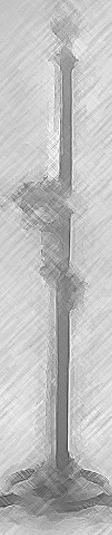

The cathetometer, devised at the beginning of the 19th century by Joseph Louis Gay-Lussac (1778-1850) and perfected by Pierre Louis Dulong (1785-1838) and Talexis Thérèse Petit, who used it in their research into the dilation of mercury, became one of the most widely-used instruments in physics and also chemistry laboratories throughout the 19th and the beginning of the 20th centuries. It underwent many changes and improvements.
In order to exploit the precision of a cathetometer to the fullest, the
staff must be perfectly vertical and the optical axis of the telescope
(that is, the line connecting the optical centre of the objective and
the centre of the reticle) and its geometric axis (that is, the axis of
its metal container) must be horizontal.
The control and calibration operations that must be performed prior to
use of the cathetometer, although quite simple, require some time and
are described in several treatises (e.g. Battelli - Cardani and Drigo
- Alocco).
The cathetometer was in use among students well into the second half of
the 20th century for the study of threads under traction and for measuring
the internal radius of a capillary and surface tension with the capillary
rise method.