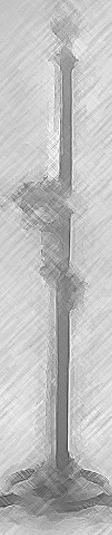


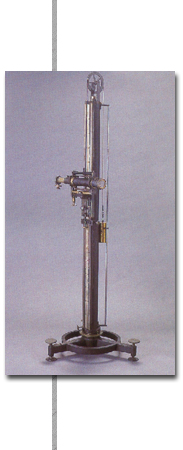
The cathetometer is a precision instrument
used in measuring the vertical distance between two points, that is, between
the horizontal planes on which they lie, independently of whether or not
they are situated on the same vertical plane.
It is essentially composed of a vertical staff capable of rotating around
its axis on which a telescope with a reticle is fixed at a ninety-degree
angle and can be moved up and down the staff and blocked in the desired
position.
Wishing to measure the difference in level between two points, the telescope
is aimed at one point and then at the other by moving it up or down the
staff and, if necessary, by rotating it with the staff: the difference
between the two readings on the scale corresponding to the two positions
gives the difference in level.
The supporting staff of the cathetometer is a sturdy cast iron staff held
vertical by a heavy tripod, it too cast iron, with three levelling screws
standing on three brass disks with notches for the tips of the screws.
Along the entire length of the staff is a steel double guide in which
a cursor and a small slide connected to each other with a long micrometric
screw. The cursor holds the telescope which lies on the forks of a brass
frame fixed by means of a horizontal pin. There is an air-bubble level
on the telescope, which also has a reticle and a focusing screw. ...continues

