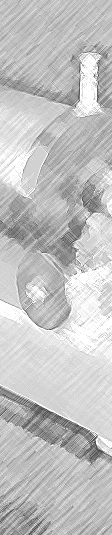

When the circuit is closed, the core is magnetized, it attracts the hammer
and detaches it from the point of the screw, thus interrupting the current;
but the reed immediately brings the hammer back to the rest position and
the circuit closes once again. The process is repeated for as long as
the pile is connected, with a frequency that depends on the mass of the
hammer and the elastic characteristics of the reed. In the secondary coil
there is induced tension the value of which depends on the ratio between
the number of its turns and the number of turns of the primary and the
rapidity of the opening and closing of the circuit.
At the moment of closing the circuit, due to the manifestation of the
making current, the current in the primary slowly reaches its operating
value and the induced current is scanty; but in practice it is impossible
to intervene to make the closure more rapid. Even at the opening the presence
of the making current, which causes a spark between the reed and the point,
greatly attenuates the speed of interruption of the current in the primary
and, therefore, the value of the tension induced in the secondary. To
reduce the deterioration caused by the sparks, each of the two contacts
is protected with platinum. ...continues