
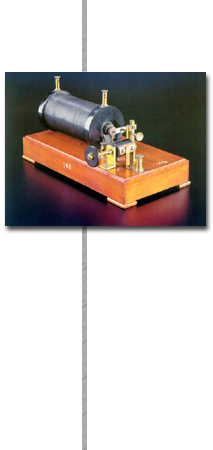
The device is known as Ruhmkorff's coil. The first exemplar was
in fact constructed in 1851 by Heinrich Daniel Ruhmkorff (1803-1877),
a German precision instrument maker who began working in Paris in 1840.
Following his death, his work was continued by the French engineer Jules
Adrien Carpèntier (1851-1921). It is a device which, when powered
by one or more piles, supplies a very high, unidirectional pulsating tension.
Presented for the first time at the Paris Exposition in 1855, it was used
to power discharge tubes and to produce x-rays. It consists of two superimposed
coils wound on a spool of laminated soft iron, one with thick copper wire
with few turns (inducer or primary coil) and the other of thin
wire with many turns (induced or secondary coil). The wire is insulated
with great care; it is in fact covered with silk and the spires are separated
one from the other by a layer of dried, fresh shellac.
In the Ruhmkorff models, in the primary coil some tens of metres (even
50) of 2 mm wire were used, while in the secondary coil the wire was a
few tenths of a millimetre in diameter and its length could reach, and
even exceed, one hundred kilometres. ...continues

