

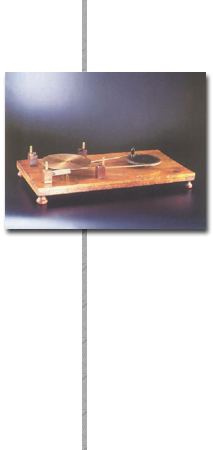
This an exemplar of the most widespread version of the device used by
Francois Arago (1786-1853) in 1824 in the experiments in which
he showed that a copper disk placed horizontally and rotating around a
vertical axis passing through its centre pulls with it a magnetic needle
(or bar magnet) free to rotate around a vertical axis passing through
its barycentre and coincident with the axis of rotation of the disk when
it is placed at a distance of a few millimetres from the disk (spin
magnetism).
The phenomenon was explained by Michael Faraday (1791-1867) in
1831 with the discovery of electromagnetic induction.
The device maintains its validity as a teaching aid in the study of induced
currents in massive conductors (eddy currents) which find their
simplest explanation in Lenz's law.
In fact, during the rotation of the disk, in all the closed paths that
can be imagined as approaching or moving away from the magnet, there is
the generation of induced currents which, by Lenz's law, on opposing the
relative disk-magnet motion, pull the magnet into the rotation. ...continues

