

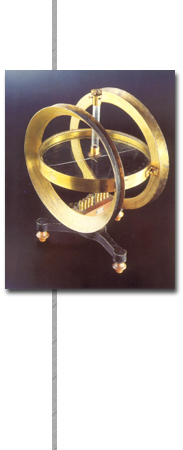
The same considerations advanced above apply to this exemplar as well;
in fact, the field created by the two coils at the centre of the magnetic
needle can easily be calculated and is still directly proportional to
the intensity of the current and the number of turns and inversely proportional
to their radius, less a numerical constant that is evaluated exactly.
The two versions of the tangent galvanometer differ not only because the
magnetic field created by the two-coil galvanometer in the region in which
the needle is located is practically uniform, but also because with the
same amount of current it is far more intense than that which is created
by the one-coil galvanometer; the consequence is that the two-coil instrument
is far more sensitive than the one-coil version.
A small magnetic needle is suspended from a thin thread having a negligible
elastic moment of torsion, in the centre of a cylindrical brass box (diameter
26 cm, height 3 cm) with a glass base and cover.
A very light, thin aluminium index joined to the needle at the centre
and normally directed to the axis, moves on a scale graduated from 0 to
360 degrees etched on the cover, with intervals of five degrees. ...continues

