


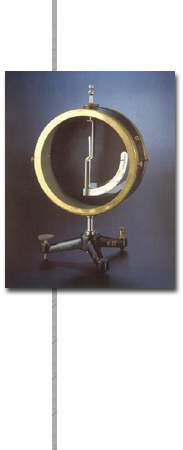
It is an instrument for measuring differences in potential of the
type invented by the German physicist Ferdinand Braun (1850-1918),
calibrated from 0 to 3500 volts (100 V/div).
It is completely screened by a cylindrical metal case painted black (diameter
20 cm, depth 8 cm) supported by a short metal staff on a black enamelled
tripod
One of the feet has a screw that adjusts the indicator to zero prior to
use.
The front and back of the case have windows giving a view of the scale
and are covered with panes of glass allowing reading of the potentials.
The panes of glass and the underlying metal covers are held in place by
a brass frame. At the top of the case the support of the needle and the
graduated scale are attached to the top of the case by means of an agate
insulating cap. The support of the needle is a flat, vertical metal rod
which, bent twice at right angles, leaves a short horizontal part stretch.
...continues

