
It was the German Ewald von George Kleist (1700-1748) who discovered
the condenser in 1745 in an attempt to build a machine for producing sparks.
Some months later the Dutch physicist Pieter van Musschenbroek
(1692-1761), a professor at the University of Leyden, attempted to produce
sparks from water. A certain Andreas Cunaeus, perhaps one of his
students who had witnessed the experiment, tried to repeat it on his own.
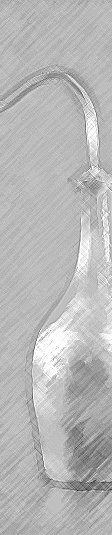
He electrified the water contained in a glass jar that he was holding
in his hand, placing the end of a metal rod inside the water in contact
with one of the poles of an electrostatic generator.
On putting down the jar he was holding in one hand, he tried to extract
the metal rod with the other and received a shock, which in his opinion
was far stronger than what could be expected with the power of the machine
he was using, and the jar fell from his hand and broke on the floor.
Musschenbroek, on being informed by Cunaeus, immediately repeated the
experiment and received a shock so strong that in a letter to Rèamur,
he wrote that he would not repeat the experiment for the entire French
kingdom. Independently of Cunaeus and Musschenbroek, Kleist performed
those experiments and discovered the condenser by chance: the plates were
the water and the experimenter's hand, while the dielectric was the glass
of the jar.
...continues