

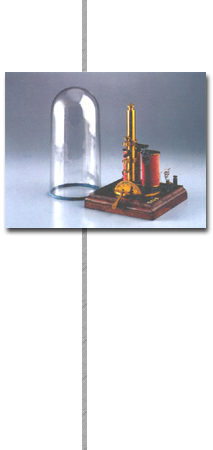
The device presented here is a model of the electromagnetic relay invented
around 1850 by the Swiss watchmaker Mathäus Hipp (1813-1893),
which took the place of those
previously used in the entire Swiss telephone
network and which allowed a reduction in the number of relays from 23
to 11.
The need to use an automatic repeater in telegraphy derived from the fact
that when the electricity that carried a message arrived at the telegraph
receiver at the end of a long line it was sometimes so weak that it would
fail to make it work. In such cases, it was of little use to increase
the power of the generator supplying the line. The discovery of the electromagnetic
relay allowed Charles Wheatstone (1801-1875) in 1858 to solve this
problem in a quite simple way by introducing a device that opened and
closed an electrical circuit under the action of a weak current in arrival.
This circuit, powered by a local generator, was capable of supplying a
sufficiently intense current to allow the receiver to work (the typical
function of a repeater relay).
An electromagnetic relay is essentially made up of an electromagnet whose
mobile armature is fixed to one of the arms of a lever. When electricity
circulates through the electromagnet, the armature is attracted by a circuit
breaker which has contacts fixed at the extremity of the other arm of
the lever and closes another circuit. ...continues

