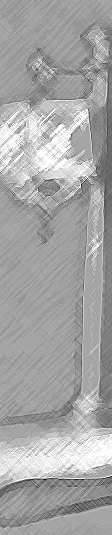

Once the poles of a natural magnet had been found, its surfaces were
worked to produce two smooth faces normal to the axis of the poles. Two
plates of very soft iron, which covered the faces completely, were applied
to these faces.
The plates, which were held closely to the faces of the magnet by a copper
frame, ended on the bottom with two short, well-flattened appendices,
usually having a rectangular section, which served as polar expansions.
A soft iron anchor was applied to the polar expansions. It had a hook
from which weights were hung to demonstrate the great force of attraction
of the magnet.
In such a way the magnet's force of attraction was greatly increased;
besides exploiting the attraction of both poles, all the lines of force
of the magnetic field were conveyed to the soft iron plates and then to
the polar expansions to which the anchor adhered perfectly.