
Evacuable radiometer
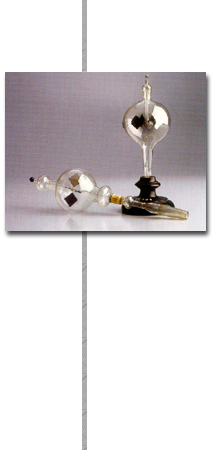
This radiometer differs from the one acquired by the Physics Laboratory
in 1887 not only in size (24 cm in height), but because its staff in open
and terminates with a frosted truncated cone which allows it to be connected
to a suction pump.
As a teaching aid it is complementary to the first one. It demonstrates
that there must be the proper amount of the residual gas in the bulb:
if the vacuum has not been created, or is insufficient, there is no rotation:
the same occurs when the vacuum is exasperated.
Indeed, in the first case collisions between the molecules of the residual
gas are quite frequent and there is no great difference in speed between
the molecules on one side and those on the other of the vanes; if the
vacuum is exasperated, collisions are too few to transfer to the vanes
the amount of motion required to turn the rotor.

